
Avenida de la Constitución
38003 Santa Cruz de Tenerife, in the Cabo Llanos area, next to the Parque Marítimo and close to the Auditorio. About 10 minutes by car from Plaza de España, not counting parking.
Garden guide · Santa Cruz de Tenerife
A 12-hectare botanical garden specialising in palms, built on a former city rubbish dump and open to the public since 2014. Opening hours, official prices, the two self-guided routes on the map, how to get there and what to see, with data from its official website and warnings where the sources disagree.
Quick answer
Data checked on 12 November 2026 on the Palmetum’s website, its official shop, Tenerife Tourism, Titsa and OpenStreetMap.
Short answer: the Palmetum of Santa Cruz de Tenerife is open every day from 10:00 to 18:00, with last entry at 17:00. According to its official website, a ticket costs €6 for a non-resident adult, €2.80 for a non-resident child and €3 for a resident adult; children under 3 go free. It is on Avenida de la Constitución, next to the Parque Marítimo César Manrique, about 10 minutes by car from Plaza de España. A full visit takes between an hour and a half and 2 hours.
38003 Santa Cruz de Tenerife, in the Cabo Llanos area, next to the Parque Marítimo and close to the Auditorio. About 10 minutes by car from Plaza de España, not counting parking.
Non-resident adult, non-resident child and resident adult. Under-3s go free. Buy online or at the ticket office.
According to Tenerife Tourism. Each self-guided route on the official map takes a little over an hour.
About 3,000 plant species according to the Palmetum, with more than 600 of palms, on an artificial hill with sea views.
Hours and tickets
Open every day of the year, with different rates for residents and non-residents.
Every day, including Sundays and public holidays. Last entry at 17:00.
They last about 1 h 30 min, are free and require advance registration.
These are the prices on the Palmetum’s price page and its online shop (in Spanish), checked on 12 November 2026 (read-only: we did not add anything to the basket). Resident discounts require proof of entitlement at the entrance.
| Ticket | Price | Note |
|---|---|---|
| Non-resident adult | €6.00 | General visitor rate |
| Non-resident child | €2.80 | The website does not give the age limit |
| Resident adult | €3.00 | With supporting documents |
| Resident over 65 | €1.50 | With supporting documents |
| Resident under 12 | €1.50 | With supporting documents |
| Resident entitled to a discount | €1.50 | Disability or large family, with documents |
| Under 3 | Free | — |
The ticket price does not include a guide. The one-hour guided tour must be requested by email at info@palmetumsantacruz.com at least 15 days ahead, for groups of fewer than 30 people. Its price differs between the two versions of the official page: €70 in Spanish and €83 in English (checked on 18 November 2026). Confirm the price with the Palmetum when you request it.
| Twin Ticket (Palmetum + Parque Marítimo) | Price |
|---|---|
| Non-resident adult | €10.50 |
| Non-resident, reduced rate (with proof) | €5.50 |
| Resident adult | €5.75 |
| Resident | €3.25 |
| Resident over 65 | €3.50 |
| Resident entitled to a discount (large family or disability) | €4.25 |
Prices from the official shop. The shop itself describes the Twin Ticket as a ticket for the Palmetum and the Parque Marítimo César Manrique; the reduced rates require proof of entitlement.
You can book online in the official shop or buy at the ticket office whenever there is capacity. If you buy online and do not receive the ticket, the Palmetum asks you to check your junk mail and write to info@palmetumsantacruz.com. The prices in this guide are the official ones; on other platforms they may differ.
The Friends of the Palmetum card costs €30 (individual, free entry for the holder for a year) or €50 (family, for two adults and accompanying children), according to the official website. For a non-resident visitor, €30 equals five €6 tickets.
What to see
Palms from all over the world, waterfalls, lakes, birds and sea views.
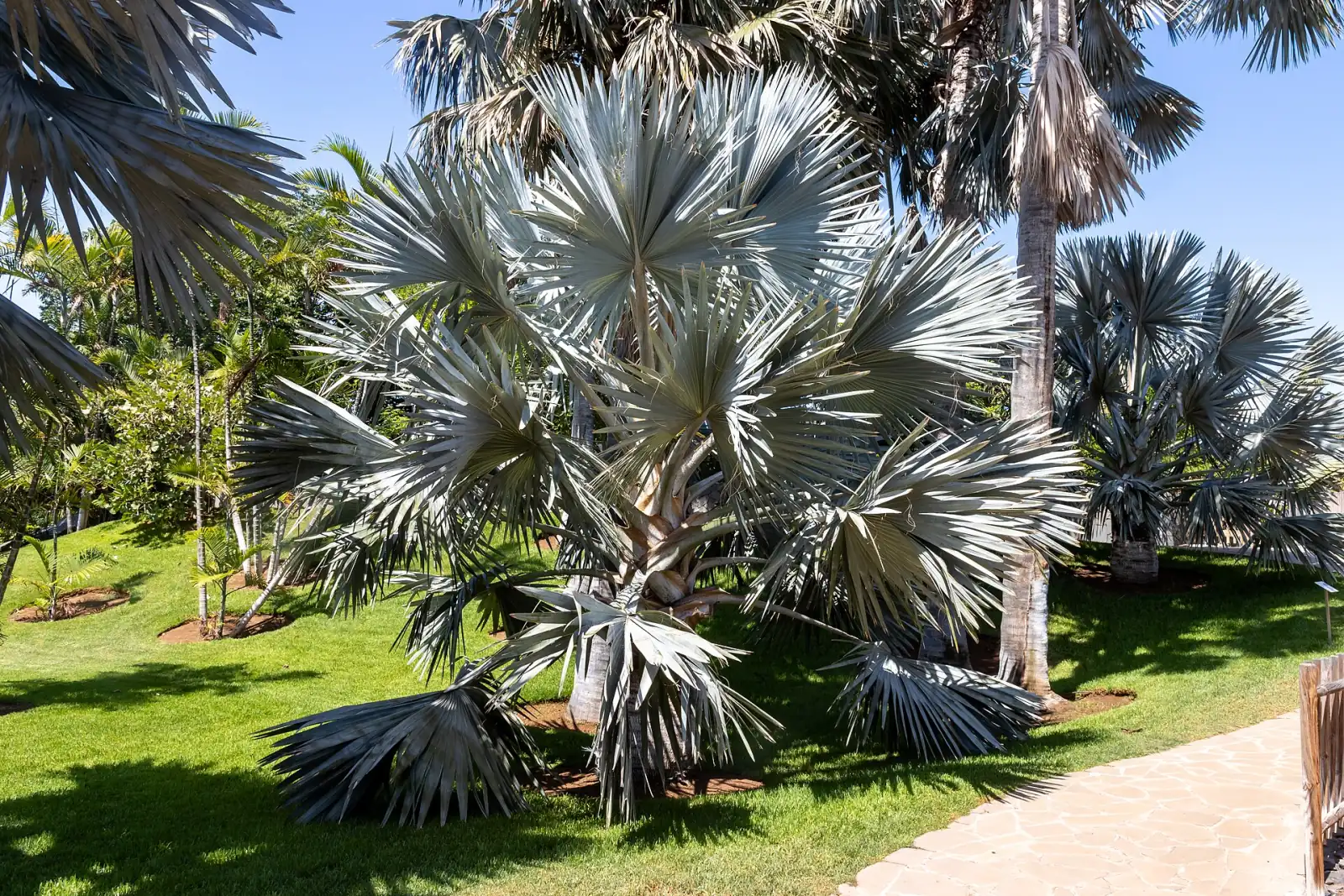
The Palmetum occupies an artificial hill about 40 metres high that was formed from Santa Cruz’s waste until 1983. According to the garden itself, it has about 3,000 plant species from tropical and subtropical climates, with more than 600 of palms laid out in geographical sections, and most of the area is devoted to island territories: Madagascar, the Caribbean, Polynesia, New Caledonia, Hawaii or the Canary Islands.
There are curious genera, such as the “belly” palms, the climbing palms used for rattan or those that give sugar and oil. The garden claims to have “the best collection of palms in Europe” and to be considered the largest botanical collection of tropical island palms in the world; this is its own claim, which we have not been able to verify.
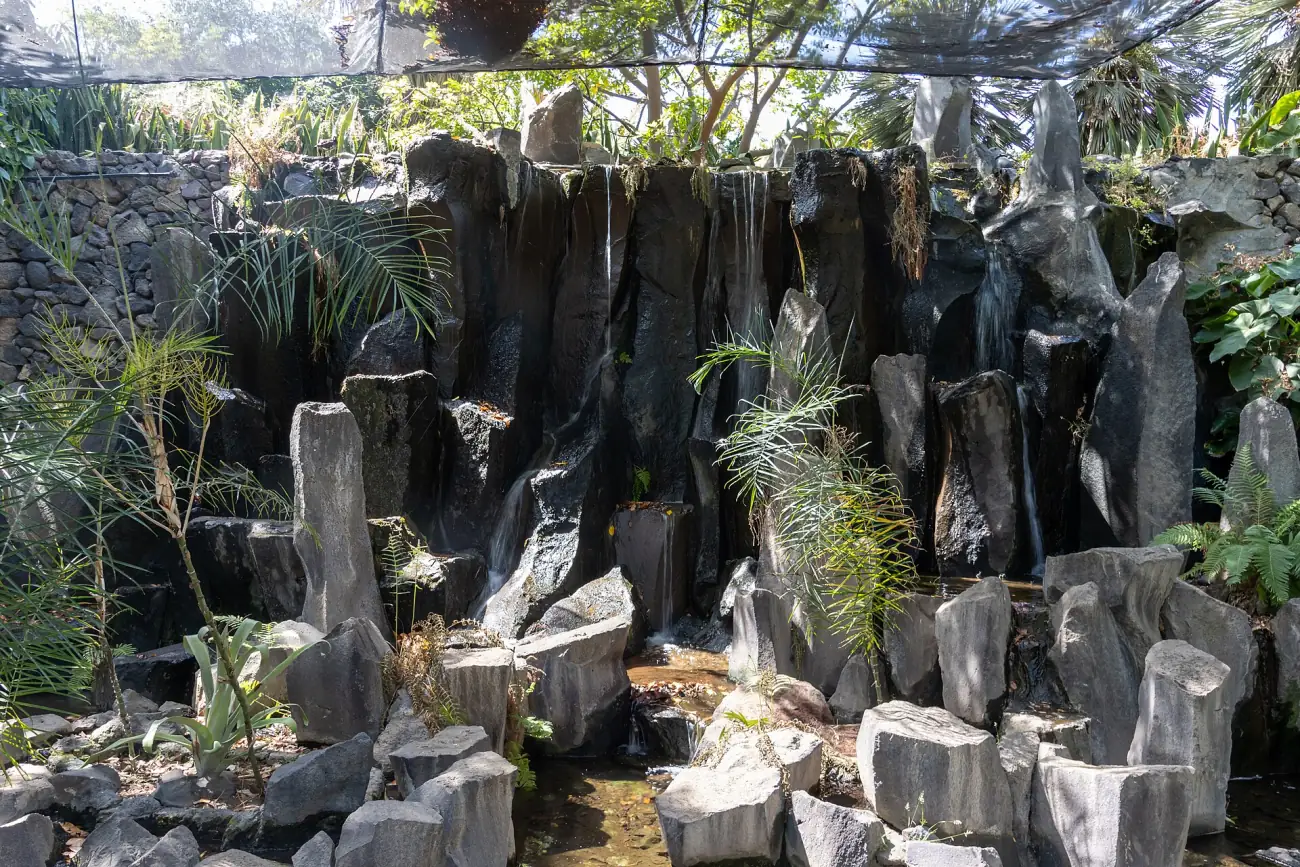
It is a partly enclosed, two-level space with a rough division between the New World and the Old World, decorated with rocks, waterfalls and streams. One of its waterfalls, of dark basalt prisms, serves as a staircase between the two levels. According to Wikipedia, it houses species that need a more constant, humid, windless environment. The map guide places three stops here (Pandanus, vanilla and mahogany; cocoa, rattan and Panama hats; “ancient” banana plants) and the official website mentions bromeliads and aroids.
Wikipedia describes it as a semi-underground shade house of 2,300 m². On OpenStreetMap the Octagon polygon measures about 2,600 m²; they are two different measurements.
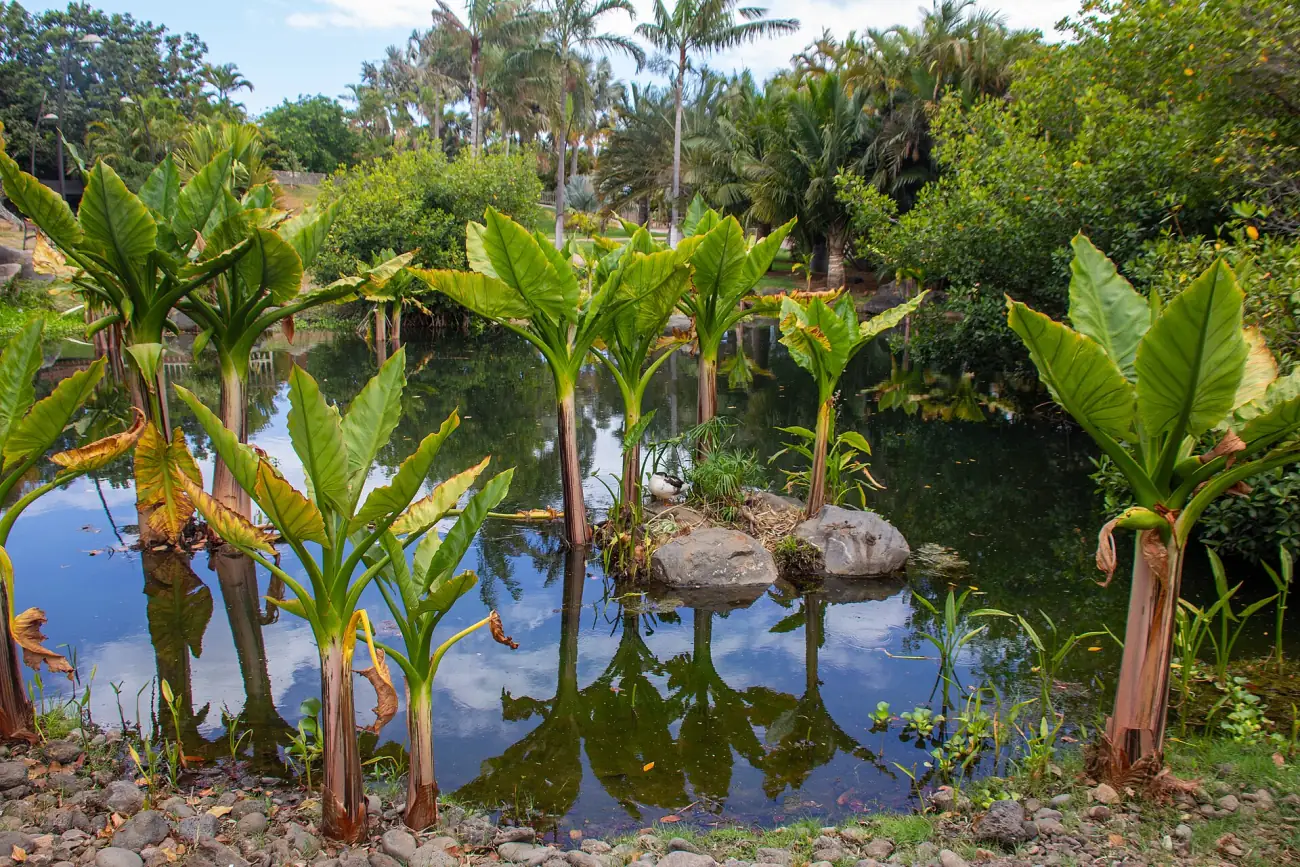
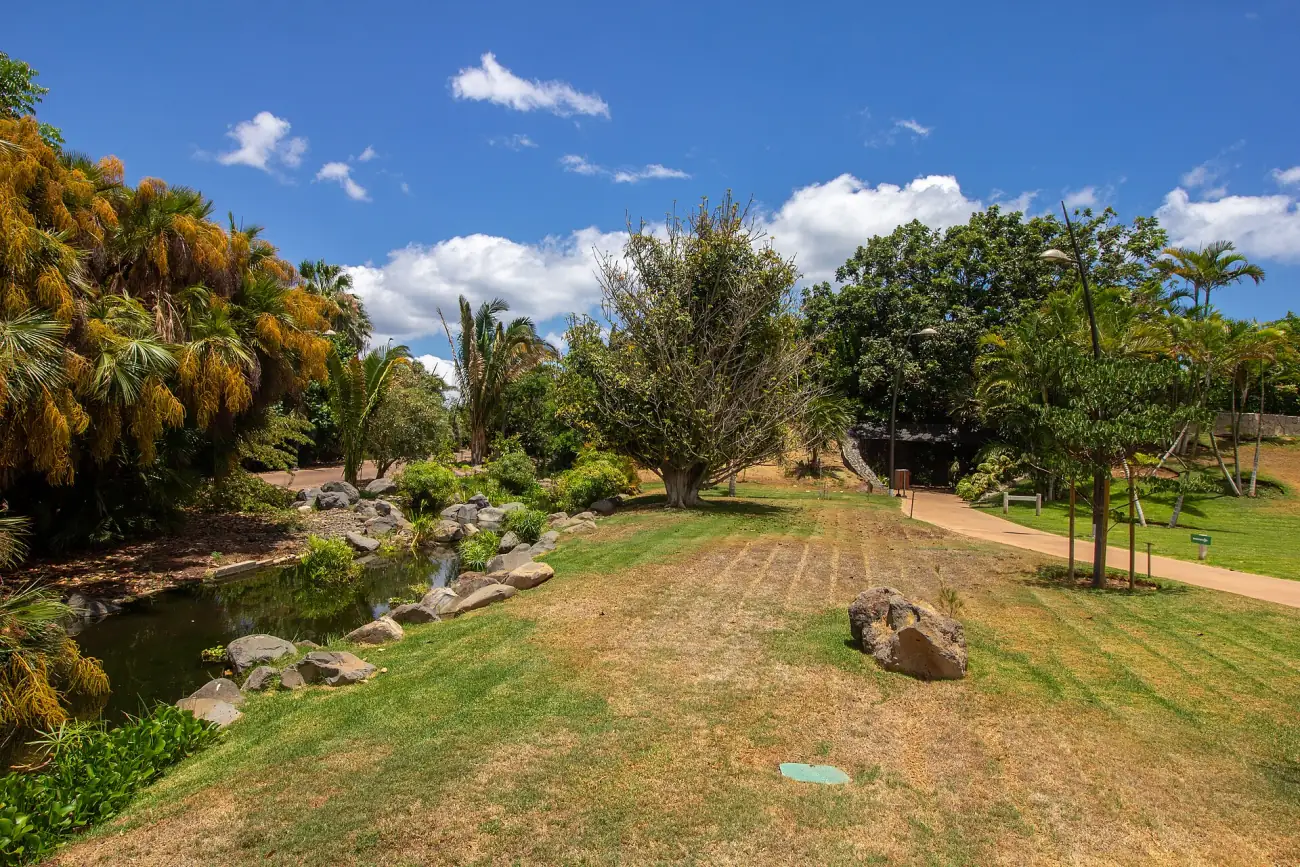
The Palmetum has two lakes joined by a stream and three waterfalls, according to its official website, plus corners with volcanic rocks and viewpoints. The larger lake is in the Madagascar section, with a wide lawn; in the main lake grow adult mangroves, with stilt-shaped roots and floating torpedo-shaped fruit.
The irrigation water is reclaimed, from the city’s treatment plant, and since 2007 the garden has used no herbicides or plant-protection products (according to the Palmetum itself). According to the Palmetum, the absence of pesticides, the lakes and the variety of habitats have favoured birds: moorhens, kestrels, hoopoes and, in the cooler months, little egrets and purple herons.
It is the largest and richest section and houses most of the valuable species, according to the Palmetum. Near the Caribbean waterfall grows the Roystonea princeps planted at the 2014 inauguration, attended by the then Prince and Princess Felipe and Letizia.
The Palmetum considers it unique for the endemic species of that archipelago. The garden also has a forest of about 50 Araucaria columnaris from New Caledonia, collected in their habitat at the end of 2000 and planted from the top of the hill down to the sea.
At 11,500 m², it is the largest native-flora garden in Santa Cruz and faces the city. According to the Palmetum, it is at its best in winter and spring and rests in summer; between November and December the sea daffodils (Pancratium canariensis) decorate the entrance in white.
There are several species, germinated since 1996. According to the Palmetum, Adansonia za and A. digitata have flowered every summer since 2012; in winter they are leafless.
Opened on 9 December 2024: 1,600 m², nearly 100 specimens of about 50 species, a lake and a bird hide, according to the Palmetum.
The map guide marks the Caribbean and Asia viewpoints, and the official website also mentions those of Africa and the Pacific; OpenStreetMap adds one for Anaga. They look over the sea and the city.
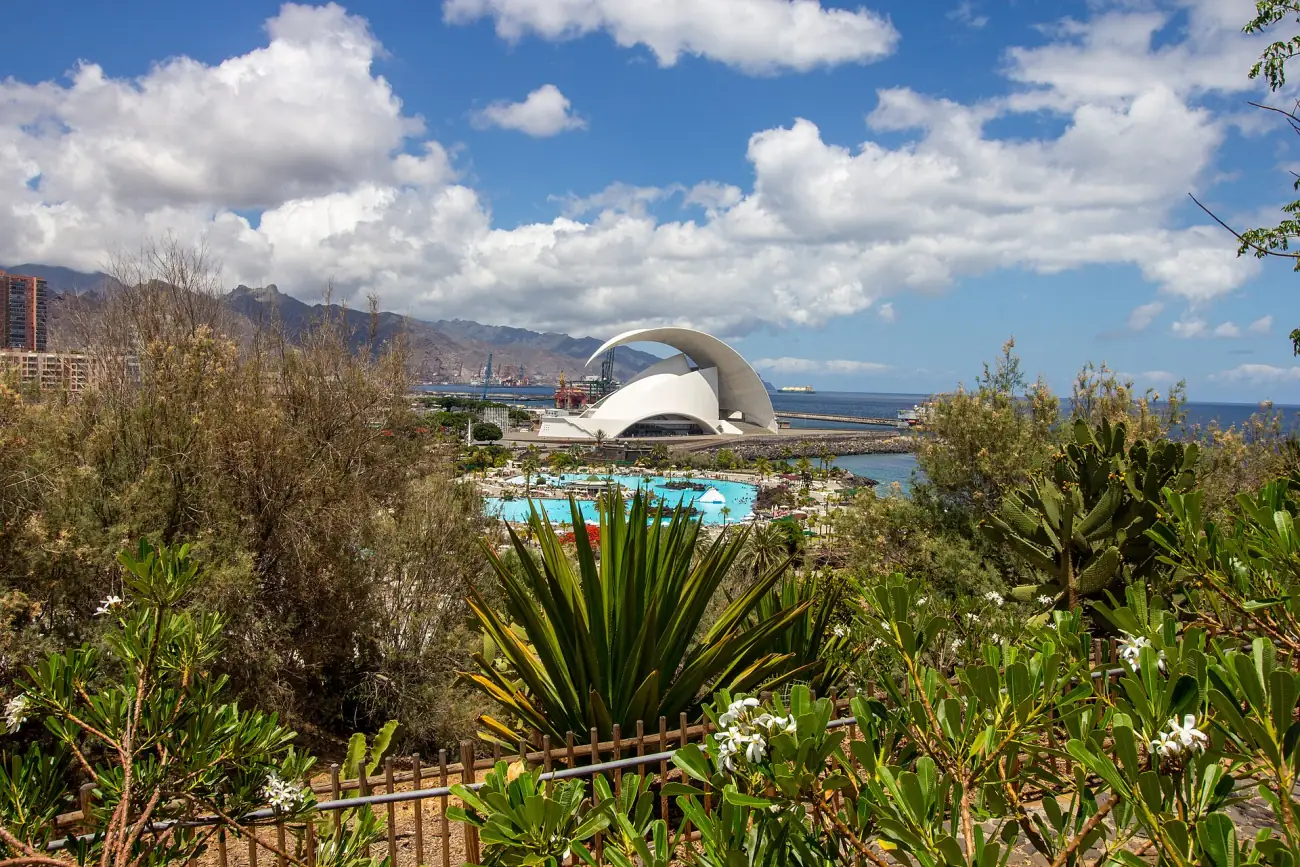
Because it is on a hill by the sea, the route offers panoramas of the Atlantic, the city and, in the distance, the Anaga mountains, according to Tenerife Tourism. From several points you can see the Auditorio de Tenerife with the Parque Marítimo pools at its feet.
There is also an entrance building with reception, shop and exhibition hall. According to Wikipedia, it displays objects related to palms, such as hats, blowpipes and a canoe; we have not been able to confirm this with the Palmetum.
Routes
Thirty-four stops to tour the garden without a guide, with an hour for each route.
The official map guide proposes two self-guided routes with 34 points of special interest. Each takes a little over an hour; they share the first four stops, on the climb up the hill, and then fork. You can download the map guide with legend (PDF); the website also offers a leaflet with suggested routes in several languages.
| No. | Stop |
|---|---|
| 1 | Canary Islands zone |
| 2 | Sustainable corner |
| 3 | Serenoa repens |
| 4 | Route fork |
According to the map, it tours the collection looking at threatened species and how they grow, with stories about the Palmetum’s wildlife and even about the city.
| No. | Stop |
|---|---|
| 1 | Madagascar baobab |
| 2 | The Lake |
| 3 | Swamp palms |
| 4 | Floss silk trees and attaleas |
| 5 | Coccothrinax borhidiana |
| 6 | Two royal palms |
| 7 | Caribbean viewpoint |
| 8 | “Princess” palm |
| 9 | Coconut palms |
| 10 | Belly palms |
| 11 | Africa in miniature |
| 12 | Borassus aethiopum |
| 13 | Red banana |
| 14 | Tahina spectabilis |
| 15 | Octagon |
Focused on useful species: eye-catching fruit trees and plants used since ancient times, such as coffee, cotton, vanilla, the breadfruit tree and a collection of banana varieties.
| No. | Stop |
|---|---|
| 1 | Wild banana plants and sugar cane |
| 2 | Breadfruit trees and edible forests |
| 3 | “Poingó” bananas and araucarias |
| 4 | Diversity of aloes |
| 5 | Octagon: Pandanus, vanilla and mahogany |
| 6 | Octagon: cocoa, rattan and Panama hats |
| 7 | Octagon: “ancient” banana plants |
| 8 | Betel nut |
| 9 | Coconut palms by the sea |
| 10 | Asia viewpoint |
| 11 | Corypha and triploid banana plants |
| 12 | Useful Africa |
| 13 | Oil palm |
| 14 | Palm “wine” |
| 15 | Cuban royal palms |
Stops taken from the Palmetum’s official map guide (PDF, in Spanish, checked on 12 November 2026) and translated by us. Scientific names are as they appear on the map. The garden notes on the map that you must not leave the path, smoke or pick seeds or parts of plants.
When to go
According to the garden itself, autumn is perhaps the best season.
The Palmetum publishes a guide by season and the general idea is that there is no bad time, only different things to see. The table summarises what its website says; it is a living garden, and flowering and fruiting depend each year on the weather.
By time of day, Tenerife Tourism advises the first hours of the morning, with milder temperatures, fewer people and better bird-watching; the last hours of the afternoon give a warmer light for photos, but bear in mind that the last entry is at 17:00 and closing is at 18:00.
| Season | What the Palmetum highlights |
|---|---|
| Autumn | The best time for tropical species, according to the Palmetum, after the summer heat. Many palms show coloured fruit, the Hibiscus schizopetalus in the Africa section flower and, between November and December, the sea daffodils decorate the entrance in white. Migratory birds such as the purple heron and the little egret arrive. |
| Winter | Pleasanter temperatures than in many parts of the island; according to the Palmetum, it is very unlikely to drop below 16 °C at night. There are red fruits on the foxtail palm and, from mid-December until February, the breadfruit tree’s fruit clusters. Baobabs and floss silk trees are leafless; the Canarian flora is at its peak. |
| Spring | It is the “awakening” season: baobabs and floss silk trees regain their leaves between April and May and the Canarian flora at the entrance is at its best. Many tropical species are still dormant. It is a good time to see migratory birds passing through. |
| Summer | The true tropical awakening: most palms flower, the baobab flowers open and, between July and August, the Metrosideros laurifolia is covered in yellow stamens for two or three weeks. The Canarian flora is dormant. Avoid the middle of the day. |
Our summary of the Palmetum’s “Seasons” page, checked on 12 November 2026. Wikipedia gives 13 °C as the lowest temperature recorded on the hill and 21.7 °C as the annual average.
History
A project of almost twenty years that opened in 2014.
The Palmetum was created in the area of the old Lazareto, land reclaimed from the sea where there had been industrial facilities and where the city piled up rubbish until 1983. The proposal to turn the hill into a botanical garden was made by Manuel Caballero and, according to the Palmetum itself, had the approval of César Manrique. The engineers José Luis Olcina and Juan Alfredo Amigó designed the buildings; according to the official website, the entrance building and the museum façade are inspired by Manrique’s style, very much present in the nearby Parque Marítimo.
In 2014 the project was selected as Spain’s candidate for the Dubai International Award for Best Practices (tenth cycle) and entered the Spanish Catalogue of Good Practices; we have not been able to check the final result of the competition.
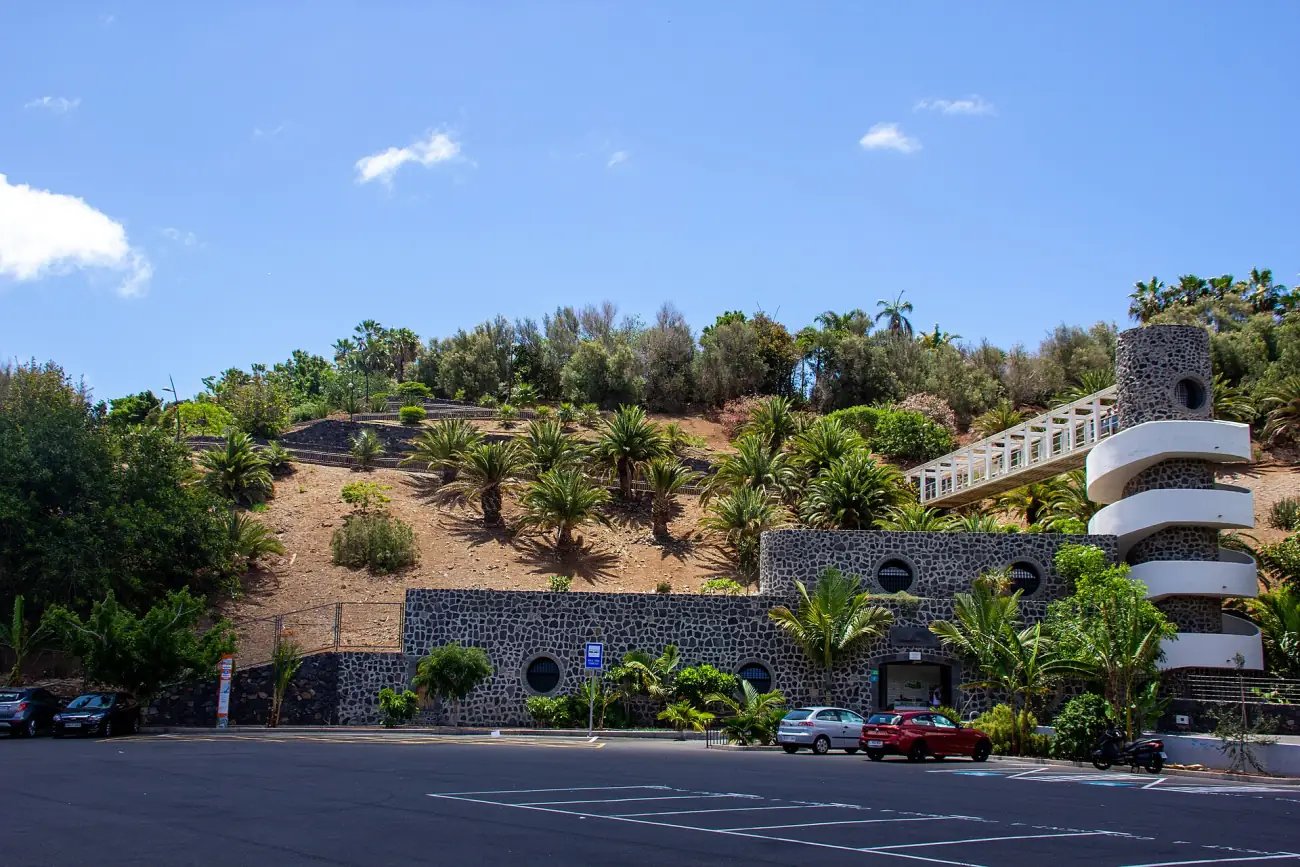
It is a two-storey building with a spiral staircase tower and a bridge connecting to the plateau. The official website attributes its design to the engineers Olcina and Amigó, and Wikipedia adds a lift in the tower. The ticket office and reception are in this area.
The official website cites Santa Cruz City Council as organiser of the inauguration and, together with the Fundación Moeve, of the inclusive visits.
Getting there
It is in Cabo Llanos, on the Santa Cruz seafront, best by car or on foot from the centre.
There is a large car park next to the Palmetum and the Parque Marítimo (the official map marks it next to the entrance). Tenerife Tourism warns that spaces are not guaranteed, that it can close for events and that it should not be assumed to be free.
OpenStreetMap marks it without a charge; confirm it with the signs on the day.
No Titsa stop is next to the entrance: the closest is about 500 m away in a straight line and about 870 m on foot, and the Meridiano stop concentrates many intercity lines. Tenerife Tourism cites lines 014, 102, 110 and 910, which end at the Intercambiador.
Check Titsa’s website or app for the timetable for the day.
Tenerife Tourism estimates 2 km on foot from the centre along Avenida Marítima. It recommends tram line 1 to Intercambiador and continuing on foot along Avenida de la Constitución. The nearest tram stop listed on OpenStreetMap, Fundación, is about 1.9 km on foot (25 min).
The adjoining car park is also used as a venue for large events, and Tenerife Tourism warns that there may be closures, access restrictions or traffic changes on those dates. If you go on a concert or fair weekend, it is safer to come by bus or leave the car in another area. The official address is Avenida de la Constitución s/n, 38003 Santa Cruz de Tenerife; the Tenerife Tourism listing gives “Avenida Marítima, 5”. The phone number is +34 922 229 368.
| From | Distance | Estimated time |
|---|---|---|
| Santa Cruz (Plaza de España) | 3 km | 10 min |
| Santa Cruz port (ferry terminal area) | 4 km | 15 min |
| San Cristóbal de La Laguna | 10 km | 15 min |
| Tenerife North Airport | 12 km | 20 min |
| Candelaria (basilica) | 19 km | 25 min |
| Las Teresitas | 11 km | 25 min |
| Puerto de la Cruz (Plaza del Charco) | 37 km | 40 min |
| Tenerife South Airport | 64 km | 75 min |
| Los Cristianos | 74 km | 70 min |
| Playa de las Américas | 75 km | 70 min |
| Costa Adeje (Fañabé) | 77 km | 70 min |
Road route calculated with OSRM to the ticket office, with a 30% margin over the theoretical time and rounded up to 5 minutes, without traffic or the search for parking.
| Stop | From the ticket office | Lines with expected arrivals in the query |
|---|---|---|
| José Emilio García Gómez (9130) | ≈ 870 m · 12 min | 905 and 935 |
| Meridiano (9413) | ≈ 970 m · 13 min | 10, 15, 20, 100, 102, 105, 108, 110, 111, 112, 120, 122, 128, 138, 231, 233, 238 and 933 |
| Manuel Hermoso Rojas (1378) | ≈ 1.0 km · 13 min | 905 and 935 |
Stops located with Titsa’s nearby-stops finder and lines read on 12 November 2026 at 7:15 at stop 9130, stop 9413 and stop 1378 (in Spanish). They are expected arrivals within an hour on a weekday, not the full list of lines at each stop; weekend services may differ. Walking times calculated with OpenStreetMap pedestrian routes.
Before you go
What the Palmetum says and what it does not detail.
The Palmetum describes itself as “a museum of living things, not a park or a play area”. The published rules are these: keep your ticket throughout the visit; a shirt or T-shirt is required; bicycles, skates and ball games are not allowed; children must always be accompanied by an adult; no picnics and no animals (assistance dogs only); smoking and vaping are forbidden; do not leave the path or pick seeds or parts of plants. The garden’s water is not drinkable.
Accessibility: the official website says the garden is 100% accessible with ramps and a lift and that electric scooters can be asked about at reception. Tenerife Tourism notes that some stretches are sloping. Inclusive visits are held on Saturdays at 10:30, with free advance registration through the web form or by email, and a sign-language interpreter can be requested in advance.
Food: picnics are not allowed. Tenerife Tourism mentions a “food truck” inside the garden, whose availability and hours may vary, and the official website does not detail what is on offer. OpenStreetMap maps a terrace with a kiosk, children’s area and toilets at the south-east end, the Terraza del Caribe, for customers. Around the Auditorio and the Parque Marítimo there are more cafés and restaurants.
Photography: the rules only require authorisation from the management and payment at the ticket office for organised photo sessions. Bring water, sun protection, a hat and comfortable shoes: much of the route is outdoors and some stretches are sloping. Phone: +34 922 229 368; email: info@palmetumsantacruz.com.
Nearby
A visit of about two hours that fits into half a day in the capital.
The centre and Plaza de España are about 2 km on foot. See the Santa Cruz de Tenerife guide.
The capital’s best-known beach is about 25 minutes by car. See the Las Teresitas guide.
The massif you see from the Palmetum’s viewpoints is a few kilometres away. Read the Anaga guide.
Another botanical garden, historic and smaller, in the north of the island: the Puerto de la Cruz Botanical Garden guide.
To decide whether to sleep in Santa Cruz or another area, see where to stay in Tenerife.
Right next to the Palmetum is the Parque Marítimo César Manrique, a complex of seawater pools sold together with the Twin Ticket, and about 950 m on foot is the Auditorio de Tenerife, which Tenerife Tourism places very close. For ideas for longer itineraries, the Tenerife in 2 days route includes the capital.
Map
Site, lakes, Octagon, viewpoints, entrance, toilets and car park.
Sources and data
Ten data points with different versions.
| Item | What each source says |
|---|---|
| Plant species | Official website and Tenerife Tourism FAQ: about 3,000. Tenerife Tourism listing: more than 2,000. Wikipedia (2016): 1,853 taxa. |
| Palm species | Official website: more than 600. Tenerife Tourism listing: more than 500. Wikipedia (2016): 573. |
| IUCN Red List | Official website, “Collections”: about a hundred species. Official website, “Sustainability”: more than 400 specimens. Wikipedia (2016): 420 species. |
| Height of the hill | Official website: 40 m. Official text on the Dubai award: 42 m. |
| Address | Official website: Avenida de la Constitución s/n. Tenerife Tourism listing: Avenida Marítima, 5 (its FAQ says Avenida de la Constitución). |
| Start of works and planting | Official website: project in 1995-1996 and works from 1996; planting, according to the website, began in 1997 (Landscapes). Wikipedia: project in 1995 and first plants in 1996. |
| Visit time | Tenerife Tourism: 1.5 to 2 hours (2 to 3 if you stop). Official map: each route takes a little over an hour. |
| Car park | OpenStreetMap: no charge. Tenerife Tourism: should not be assumed to be free without checking. |
| Minimum temperature | Official website: very unlikely to drop below 16 °C at night. Wikipedia: 13 °C lowest recorded on the hill. |
| Guided-tour price | Spanish version of the official price page: €70. English version of the same page: €83 (checked on 18 Nov 2026). For groups of fewer than 30 people. |
For opening hours and prices we use the Palmetum’s official website and its shop; for context, Tenerife Tourism. Wikipedia is a secondary source: use it as a guide. The partial inventory of the Palmetum (PDF) dates from August 2014 and cannot be used to count current species.
Book ahead
This GetYourGuide card sells the Palmetum ticket for the day you pick and, according to its listing, with free cancellation up to 24 hours before. The official rate and opening hours are in the hours and tickets section.
These are affiliate links: if you book through them, we earn a small commission at no extra cost to you. GetYourGuide confirms price and availability on its booking page.
Frequently asked questions
Short answers, with the data and the source.
According to its official website (checked on 12 November 2026), a ticket costs €6.00 for a non-resident adult and €2.80 for a non-resident child. Residents pay €3.00 (adult) or €1.50 (over-65s, under-12s and those entitled to a discount), and children under 3 go free. Discounts require supporting documents. The price does not include a guide.
It is open every day, including Sundays and public holidays, from 10:00 to 18:00, and the last entry is at 17:00. This is the schedule the Palmetum publishes on its website; Tenerife Tourism and OpenStreetMap repeat it. Plan to arrive at least an hour and a half before closing to see it without rushing.
Tenerife Tourism estimates 1.5 to 2 hours for the main sections, and 2 to 3 if you read the labels, take photos or watch birds. Each of the two self-guided routes on the official map takes “a little over an hour”. The guided tour lasts an hour and must be requested by email at least 15 days ahead; the Spanish version of the official price page gives €70 for groups of fewer than 30 people, while its English version says €83 (checked on 18 November 2026), so confirm the price when you request it.
It is not compulsory. The official website says you can buy online in its shop or directly at the ticket office while there is capacity. If you buy online, changes are made before 23:59 on the day before your visit from the link in your order.
Yes. The official shop sells the Twin Ticket, a ticket for the Palmetum and the Parque Marítimo César Manrique: €10.50 for a non-resident adult and resident rates from €3.25. In addition, the Friends of the Palmetum card costs €30 (individual, free entry for a year) or €50 (family, for two adults and accompanying children).
There is no Titsa stop next to the entrance: the closest we have found, “José Emilio García Gómez” (9130), is about 500 m away in a straight line and about 870 m on foot (about 12 minutes), and the “Meridiano” stop (9413), with many intercity lines, is about 970 m away. Tenerife Tourism recommends the tram (line 1) to Intercambiador and continuing on foot along Avenida de la Constitución; the nearest tram stop on OpenStreetMap, Fundación, is about 1.9 km on foot.
There is a large car park next to the Palmetum and the Parque Marítimo, and the official map marks it next to the entrance. Tenerife Tourism warns that spaces are not guaranteed, that it can close for events and that it should not be assumed to be free without checking. OpenStreetMap marks it without a charge, but check the signs on the day.
The official website says the garden is “100% accessible” thanks to ramps and a lift, and that electric scooters can be asked about at reception. Tenerife Tourism notes that some stretches are sloping. Inclusive visits are on Saturdays at 10:30, free and with advance registration.
Animals are not allowed, except assistance dogs; picnics are not allowed, the garden’s water is not drinkable, smoking and vaping are forbidden and you must not leave the path or pick seeds or parts of plants. A shirt or T-shirt is required. Photo sessions need authorisation from the management and payment at the ticket office; the published rules say nothing more about taking photos during a normal visit.
The official website speaks of about 3,000 plant species, with more than 600 of palms. The Tenerife Tourism listing says more than 2,000 species and more than 500 of palms, and Wikipedia cited in 2016 about 1,853 taxa and 573 palm species. These are figures from different dates and criteria: take them as an order of magnitude.
According to the Palmetum, autumn is perhaps the best season to see the tropical species at their peak, although every season has something: summer is the awakening of most palms and baobabs, and winter and spring favour the Canarian flora and the birds. Early in the day it is cooler and quieter; avoid the middle of the day in summer.
If you like plants, botany or quiet walks with views of the sea and the city, yes: it is a large garden, with waterfalls, lakes and birds, about 10 minutes by car from Plaza de España and with a €6 ticket for the non-resident visitor. If you are after attractions, this is not it. It combines well with the Parque Marítimo and the Auditorio.
Sources
Official sources first; secondary ones are flagged as such.
The Palmetum is a two-hour visit. The rest of the day can be the Parque Marítimo, the old town of Santa Cruz or Las Teresitas beach.
Silver palms photo: Mike Peel, Wikimedia Commons (CC BY-SA 4.0) · Octagon photo: Mike Peel, Wikimedia Commons (CC BY-SA 4.0) · Lake photo: Mike Peel, Wikimedia Commons (CC BY-SA 4.0) · View of the Auditorio photo: Mike Peel, Wikimedia Commons (CC BY-SA 4.0) · Lawn and stream photo: Mike Peel, Wikimedia Commons (CC BY-SA 4.0) · Entrance building photo: Mike Peel, Wikimedia Commons (CC BY-SA 4.0)