
Calle Retama, 2
38400 Puerto de la Cruz, in the La Paz district. About 10 minutes by car from Plaza del Charco (5 to 10 according to Tenerife Tourism), not counting parking.
Garden guide · Puerto de la Cruz, Tenerife
The La Orotava Acclimatisation Garden, created in 1788 by order of Charles III, is a historic garden of about 20,000 m² with giant tropical trees, ponds and the famous Lord Howe fig. Opening hours, price, how to get there, what to see and its history, with official data and warnings where the sources disagree.
Quick answer
Data checked on 12 November 2026 with Tenerife Tourism, the ICIA, the Boletín Oficial de Canarias, Titsa and OpenStreetMap.
Short answer: the Puerto de la Cruz Botanical Garden, officially the La Orotava Acclimatisation Garden, is open every day from 9:00 to 18:00, except 1 January, Good Friday and 25 December. According to the Tenerife Tourism listing, a ticket costs €3 and a visit takes between 45 minutes and an hour and a half. It is at Calle Retama 2, in the La Paz district, about 10 minutes by car from the centre of Puerto de la Cruz.
38400 Puerto de la Cruz, in the La Paz district. About 10 minutes by car from Plaza del Charco (5 to 10 according to Tenerife Tourism), not counting parking.
Price from the Tenerife Tourism listing. It does not mention reduced rates or free entry: confirm with the garden.
According to Tenerife Tourism. The 20-species audio route makes the visit longer.
Founded in 1788, declared a Site of Cultural Interest in 1994. About 20,000 m² open to the public.
Hours and tickets
Open every day of the year except three dates.
Every day. Closed on 1 January, Good Friday and 25 December.
Monday to Friday, by appointment only. Not part of the normal visit.
These are the opening hours and the price published in the garden’s Tenerife Tourism listing, checked on 12 November 2026. The official tourism portal of the Canary Islands agrees on the basics: it can be visited all year round and closes at six in the evening. The listing gives no last-entry time, no reduced rates and does not say whether you can book online, and we have not found a ticket shop for the garden: expect to pay at the entrance and confirm with the garden if your case requires it.
Contact: the Tenerife Tourism listing gives +34 922 38 35 72; Spain.info and the ICIA page give the email jao@icia.es and the phone numbers +34 922 922 978 and +34 922 922 981. They do not match, so try whichever works.
The Tenerife Tourism listing gives €3. Some unofficial websites give €3.50. The price that counts is the one you are charged at the door.
The 20-species audio route works with your phone, thanks to the plaques with QR or NFC codes next to the plants. The PDF guide, the species plan and the mobile self-guide are on the ICIA website.
What to see
Giant trees, ponds and a collection that has been growing since 1788.
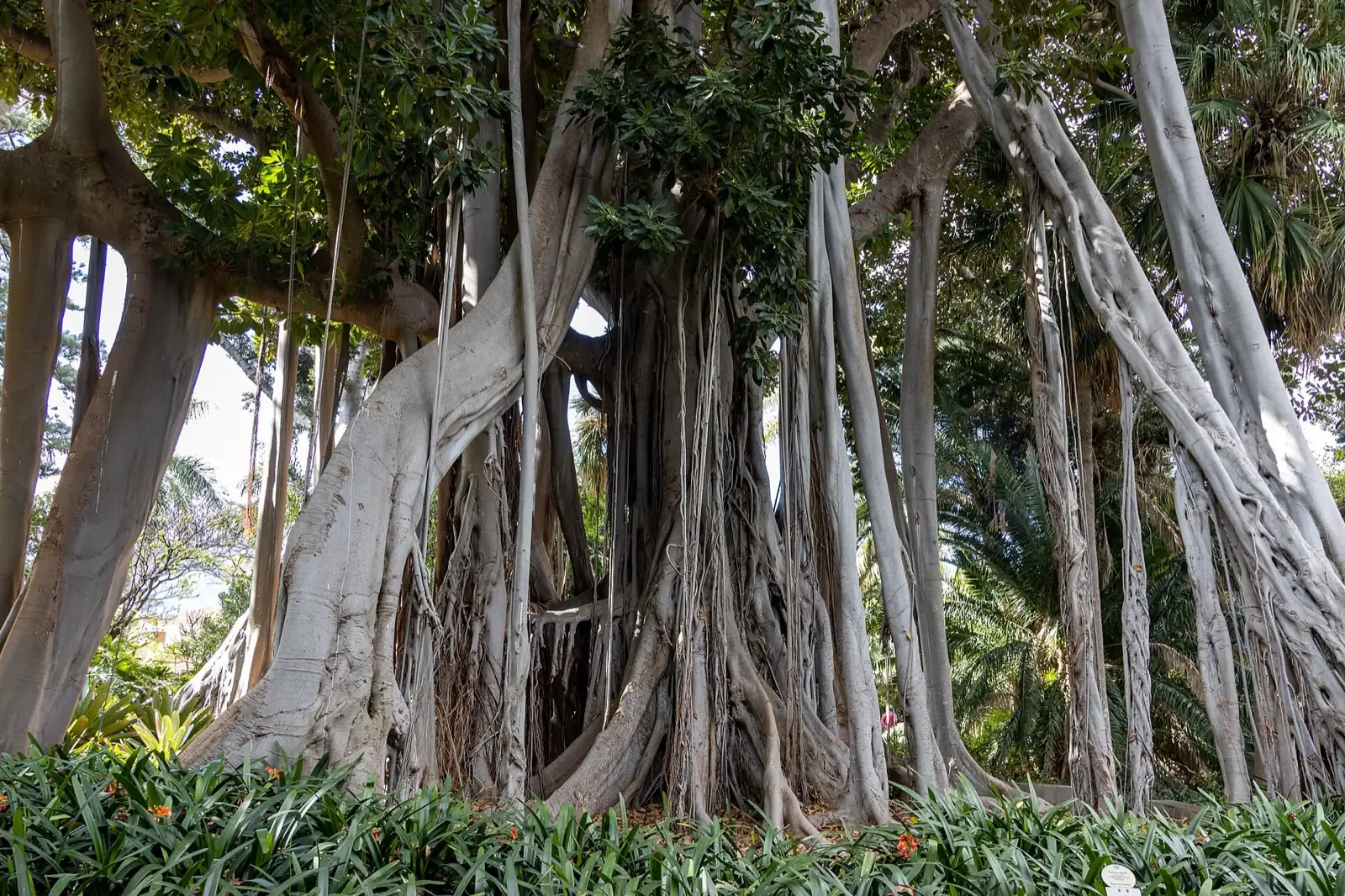
It is the tree everyone photographs: a Ficus macrophylla f. columnaris whose branches drop aerial roots that, on reaching the ground, thicken into columns and hold up the crown. According to the ICIA’s audio guide it was planted in the 1870s, when the botanical gardener was Hermann Wildpret, and today it is an icon of the garden. Its columnar form is native to Lord Howe, a small island 600 km east of Australia.
The ICIA puts its age at about 150 years and considers it the garden’s emblem. Bromeliads, clivias and agapanthus grow in its shade.
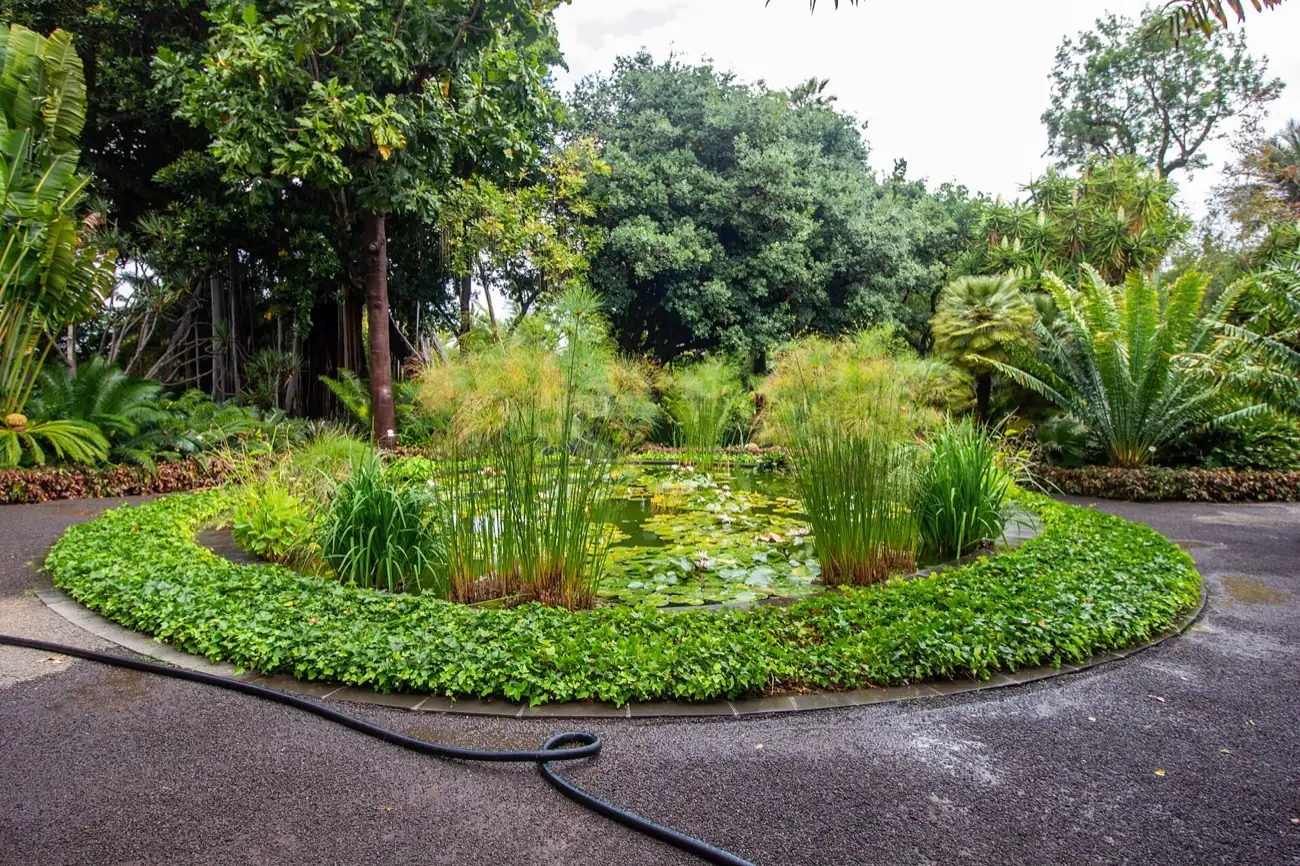
According to the ICIA, the garden has three ponds for water plants and three shade houses for plants that shun direct sun, where mostly aroids and bromeliads are displayed (this is how the 1994 protection decree describes it). Among the old trees, the ICIA highlights the mamey of Santo Domingo at the entrance, the South American rosewood at the back and the Norfolk Island pine, which according to the ICIA is the garden’s “roof”.
Beneath the trees grow countless bromeliads, clivias and agapanthus; the shrub with hanging maracas, the wild bananas laden with seeds and the shy mimosa, whose leaves fold at a touch, are a hit with the public, according to the ICIA.
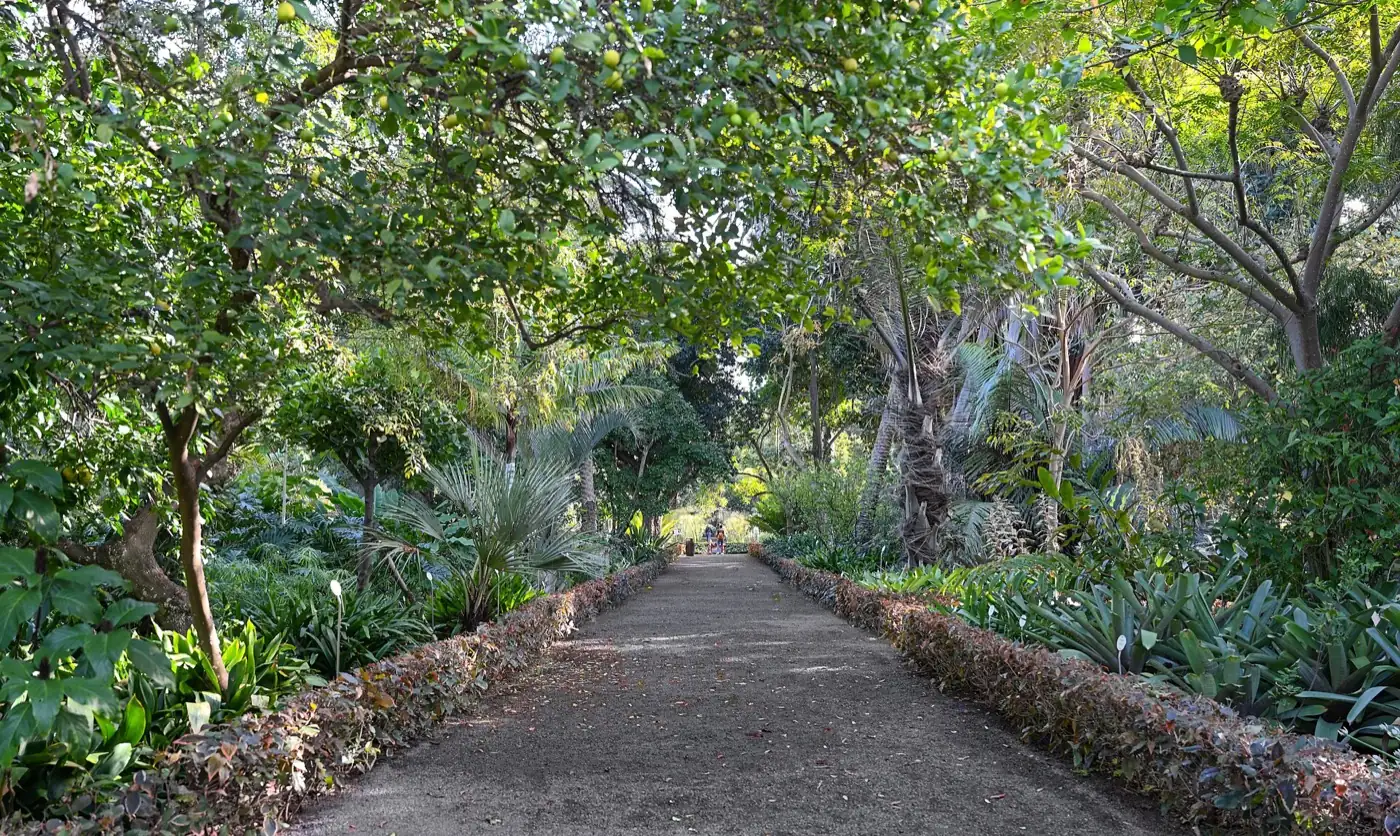
The 1994 decree describes a garden “in rectangular plots following the 24 linear classes”, dated to 1794. The photo of the main avenue, with trimmed hedges on either side, gives an idea of that order. The site open to the public measures 20,000 m²; another 10,000 m² are support areas with laboratories, a germplasm bank and a herbarium.
The ICIA says it brings together “about 1,000 plant species” from the five continents on two hectares, with its doors open practically all year.
The garden is run by the Instituto Canario de Investigaciones Agrarias (ICIA), part of the Canary Islands Government, which manages it as a botany and plant genetic resources unit.
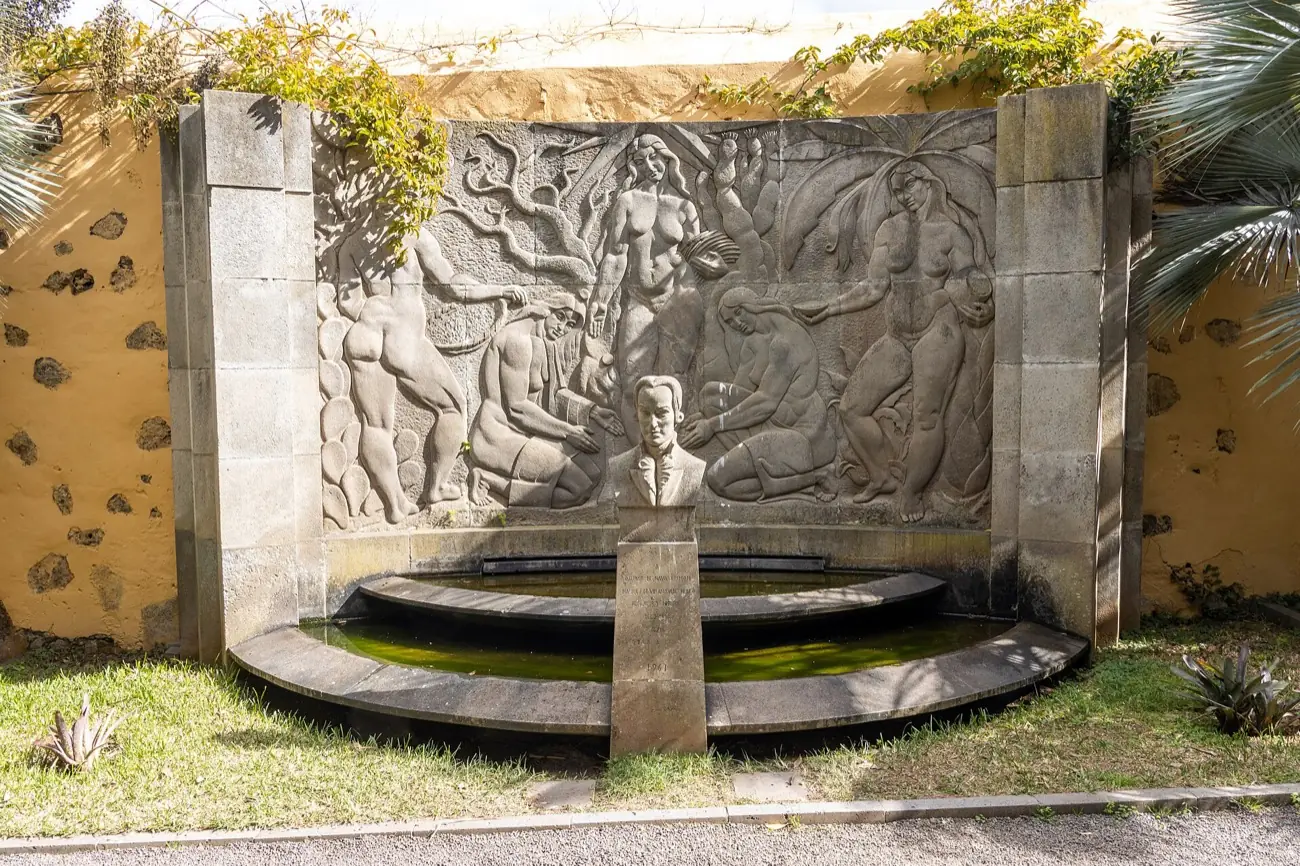
A monument with his bust commemorates the Marquis of Villanueva del Prado, who directed the creation of the garden from 1788. It stands next to a fountain and a round pond.
The garden’s Jubaea chilensis is stop 4 on the audio route. OpenStreetMap lists it as planted around 1860, an approximate date we have not been able to confirm.
It arrived at the garden on 10 June 1914, according to the audio guide. It is a female about 4 m tall that had its first viable offspring in 2003.
A wall preserves an inscription with that year. The 1994 decree dates the present garden to 1794 and Tenerife Tourism places the first plantings in 1792.
The ICIA cites a herbarium (ORT) with more than 46,000 sheets, a seed bank and laboratories. The library and the herbarium can be visited by appointment (Tenerife Tourism listing).
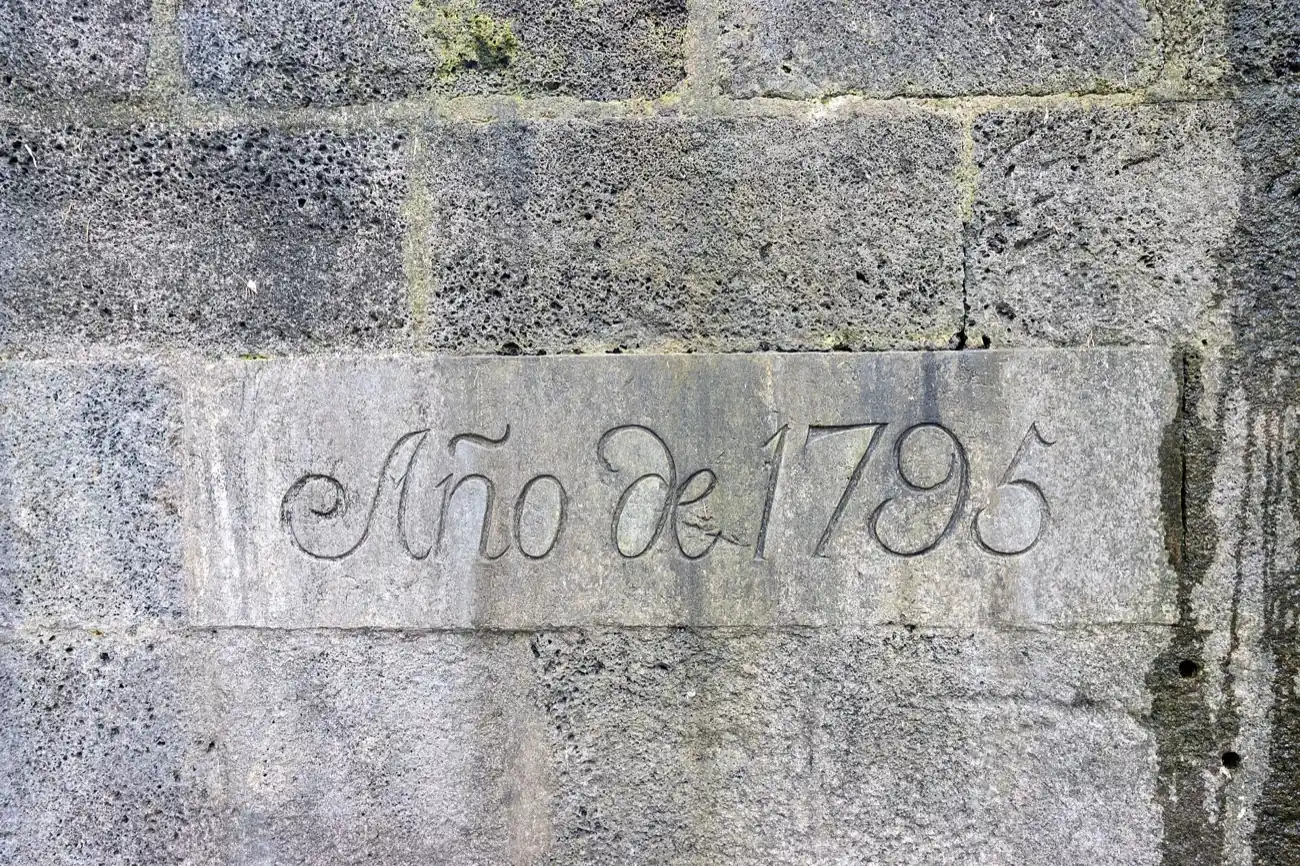
The dates depend on what you count. Charles III’s Royal Order is dated 17 August 1788. Tenerife Tourism says that in 1790 the project was drawn up and work began on plans by the architect Nicolás Eduardo, and that planting began in 1792. The protection decree dates the present garden, with its structure of plots, to 1794. And on one wall you can read “Año de 1795”.
They are not contradictions: they are stages of a project that lasted years. But it is worth knowing that there is no single “opening” date and that anyone who gives just one is simplifying.
Audio route
A tour guided by your phone, from the Lord Howe fig to the camphor tree.
The ICIA offers an audio route of 20 species. Next to each plant there is a plaque where, with a QR code or via NFC, you can instantly access an interpretive audio on your phone. The same content is in a PDF guide and in a mobile self-guide (both in Spanish). The species plan locates each specimen.
| No. | Species | What the audio guide says |
|---|---|---|
| 1 | Ficus macrophylla f. columnaris | The Lord Howe fig: planted in the 1870s and today the garden’s icon. |
| 2 | Ceiba speciosa | Floss silk tree (palo borracho): the largest specimen in the Canary Islands, according to the ICIA. It flowers pink between September and November. |
| 3 | Bananas (Musa spp.) | Table bananas have no seeds, but in South-East Asia there are banana plants with seeded fruit. |
| 4 | Jubaea chilensis | Chilean wine palm. Darwin considered it in 1834 an “ugliness among palms”, according to the audio guide. |
| 5 | Ginkgo biloba | A living fossil that has changed very little in the last 200 million years. |
| 6 | Coffea arabica | Coffee, with the legend of the Ethiopian shepherd Kaldi and his goats. |
| 7 | Enterolobium contortisiliquum | Monkey’s ear or timbó: the name comes from its ear-shaped fruit. |
| 8 | Encephalartos laurentianus | Arrived on 10 June 1914; first viable offspring in 2003. |
| 9 | Elaeis guineensis | The oil palm, native to humid tropical Africa. |
| 10 | Ficus sycomorus | Sycamore fig or pharaohs’ fig, whose wood was used in Egyptian sarcophagi. |
| 11 | Agathis dammara | It exudes an amber-like resin, “Manila copal”. |
| 12 | Artocarpus altilis | The breadfruit tree, the star of “Mutiny on the Bounty”. |
| 13 | Brugmansia versicolor | Large, fragrant flowers on a highly toxic plant. |
| 14 | Litchi chinensis | The lychee, cultivated since imperial China. |
| 15 | Manilkara zapota | The latex of this tree gave the chicle already used by the Maya. |
| 16 | Rhopalostylis baueri | Norfolk Island palm, with bright red fruit. |
| 17 | Tipuana tipu | The oldest tipuana in the Canary Islands, according to the ICIA; yellow flowers in summer. |
| 18 | Apollonias barbujana | Barbusano, a Canarian tree planted by Sabin Berthelot around 1824-1826. |
| 19 | Carludovica palmata | Its young leaves are woven into Panama hats. |
| 20 | Cinnamomum camphora | Camphor, with Japanese legends and uses already known to the Egyptians. |
Our summary of the ICIA audio guide (23-page PDF, in Spanish) checked on 12 November 2026. On the map below, the gold dots are the specimens of these 20 species according to the ICIA plan; some, such as the bananas or the brugmansias, have many specimens, and we do not know which one carries the plaque.
History
More than two centuries of tropical plants acclimatised in the north of Tenerife.
The Crown wanted to grow on Spanish soil the useful plants of its tropical possessions, and Tenerife, with its mild climate, seemed the place. The task fell to Alonso de Nava y Grimón, 6th Marquis of Villanueva del Prado, who according to the ICIA directed the project and to whom we owe the fact that we can enjoy this garden today, “the greatest work of the Spanish Enlightenment in the Canary Islands”. Wikipedia adds that moving the plants to the Peninsula did not work, because the climate of inland Spain is very different from that of Tenerife.
Today the garden combines collection, research and outreach: it has laboratories, a seed bank and a herbarium with more than 46,000 sheets, according to the ICIA (the 1994 decree spoke of more than 30,000).
The garden also includes its Hijuela (“little offshoot”), a small garden next to the town hall of La Orotava that dates from the late 19th century (ICIA). It was declared a Site of Cultural Interest with the category of historic garden by Decree 226/2008. It is not the same site and this guide does not cover its opening hours, which we have not been able to verify.
In the 1980s the planning was changed to allow the garden to be extended onto an adjoining plot of about 40,000 m². According to Diario de Avisos (27 November 2025), the building was almost finished in 2009, the terraces were built and the vegetation unplanted, and local residents were asking for the works to be completed. Wikipedia gave 2017 as the opening date, which was not met. The official listing does not mention the extension and today’s visit is the historic site.
Getting there
It is in La Paz, at the entrance to Puerto de la Cruz on the TF-5, well served by bus.
Stop 4151 has Titsa lines 30, 100, 103, 345, 351 and 363, heading to Puerto de la Cruz. In the opposite direction, the “Puente del Botánico” stop (4045), about 400 m away, has the same lines.
Check the timetable for the day on Titsa’s website or app.
According to Tenerife Tourism, you leave the TF-5 towards Puerto de la Cruz and continue along urban roads to La Paz. From the centre it is about 5 to 10 minutes.
The official sources mention no parking of its own. OpenStreetMap marks public car parks about 170 m away; we have not verified spaces or charges.
Tenerife Tourism estimates 15 to 25 minutes from the centre of Puerto de la Cruz, with some slope on the final stretch towards the upper part.
To go and come back without hills, the bus or a taxi is better.
| From | Distance | Estimated time |
|---|---|---|
| Puerto de la Cruz (Plaza del Charco) | 2 km | 10 min |
| La Orotava (Plaza de la Constitución) | 5 km | 10 min |
| Los Realejos | 13 km | 25 min |
| San Cristóbal de La Laguna | 27 km | 30 min |
| Santa Cruz de Tenerife | 36 km | 35 min |
| Tenerife North Airport | 29 km | 35 min |
| Icod de los Vinos | 27 km | 40 min |
| Los Gigantes | 60 km | 80 min |
| Costa Adeje (Fañabé) | 73 km | 90 min |
| Playa de las Américas | 76 km | 90 min |
| Los Cristianos | 77 km | 95 min |
| Tenerife South Airport | 92 km | 105 min |
Road route calculated with OSRM to the Calle Retama entrance, with a 30% margin over the theoretical time and rounded up to 5 minutes, without traffic or the search for parking.
| Line | Route according to Titsa | Notes |
|---|---|---|
| 30 | Puerto de la Cruz – La Paz – Puente del Botánico – El Durazno – motorway – Tenerife North Airport | About 30 min. “Jardín Botánico” stop (4151). |
| 100 | Santa Cruz – Hospital Universitario – Campus de Guajara – TF-5 – El Canario – El Durazno – Puente del Botánico – Jardín Botánico – La Paz – Puerto de la Cruz | About 40 min. Towards Santa Cruz it does not drop passengers at El Botánico. |
| 103 | La Laguna – El Canario – El Durazno – Jardín Botánico – La Paz – Puerto de la Cruz Station | About 30 min; Titsa calls it “direct via El Botánico”. |
| 345 | Puerto de la Cruz Station – El Botánico – La Orotava – Aguamansa | About 1 h in total. |
| 351 | Puerto de la Cruz Station – El Botánico – La Orotava Station | About 20 min. |
| 363 | Puerto de la Cruz – El Botánico – Los Realejos – San Juan de la Rambla – Icod – Garachico – Buenavista | About 1 h 30 min in total. |
| 385 | Puerto de la Cruz – El Durazno – El Botánico – Hospiten Bellevue – Parque Taoro – Casco Botánico | Circular, about 45 min; weekdays only in the timetable we checked. A different “Jardín Botánico” stop (5273). |
Titsa lines and stops checked on 12 November 2026 (in Spanish: stop 4151, stop 4045 and stop 5273; timetables for lines 100, 103, 30, 345, 351, 363 and 385). The Tenerife Tourism listing cites lines 103, 100, 351 and 363; Titsa’s query adds 30, 345 and 385.
Before you go
Practical information and gaps in the sources.
The official sources we have consulted say nothing about accessibility, pets, photography, food or visits with children. We do not take that as a yes or a no. What we do know from OpenStreetMap is that the paths are mapped as fine gravel with several flights of steps, and that there are benches around the site. It is not an official plan.
The visit is short and in the shade of large trees. Bring water, comfortable shoes and, if you want to follow the audio route, a phone with battery and headphones. For specific questions, the garden gives the email jao@icia.es and the phone numbers +34 922 922 978 and +34 922 922 981, and the Tenerife Tourism listing gives +34 922 38 35 72.
Nearby
A short visit that fits into half a day in Puerto de la Cruz.
The garden is at the edge of the old town. For the promenade, the harbour and the pools, read the Puerto de la Cruz guide.
The César Manrique pools are on the seafront of Puerto de la Cruz. See the Lago Martiánez guide.
About 10 minutes by car, with the Hijuela del Botánico. More in the La Orotava guide.
About 40 minutes by car, with the island’s most famous dragon tree: the Drago Milenario guide.
Map
Site, audio-route specimens, entrance, car parks and bus stop.
Sources and data
Eight data points with different versions.
| Item | What each source says |
|---|---|
| Number of species | ICIA: about 1,000 species. Spain.info: more than 3,000 species. ICIA species plan: 2,998 points and 1,069 different names (our count, with some “sp.” entries). |
| Herbarium sheets | 1994 decree: more than 30,000 sheets. ICIA: more than 46,000 sheets (ORT herbarium). |
| Area | 1994 decree: 20,000 m² open to the public and about 10,000 m² of services. ICIA: “two hectares”. Wikipedia: 20,000 m². |
| Dates of creation | Royal Order: 1788. Tenerife Tourism: project and works in 1790, planting in 1792. 1994 decree: present garden from 1794. A wall in the garden: 1795. |
| Phone number | Tenerife Tourism: 922 38 35 72. Spain.info and ICIA: 922 922 978 and 922 922 981. |
| Price | Tenerife Tourism: €3. Unofficial websites: €3 or €3.50. |
| Buses | Tenerife Tourism: 103, 100, 351 and 363. Titsa (12 Nov 2026): also 30, 345 and 385. |
| Extension | Wikipedia: opening planned for 2017. Diario de Avisos (27 Nov 2025): still not open. |
For opening hours and price we use Tenerife Tourism; for the history and the collections, the ICIA, which runs the garden, and the protection decree in the BOC. Wikipedia and Diario de Avisos are secondary sources: use them as a guide and confirm anything important with the garden.
Frequently asked questions
Short answers, with the data and the source.
The Tenerife Tourism listing gives €3 per ticket (checked on 12 November 2026). It does not mention reduced rates or free entry, so it is worth confirming with the garden. Some unofficial websites give €3 and others €3.50.
It is open every day from 9:00 to 18:00 and closed on 1 January, Good Friday and 25 December, according to Tenerife Tourism. The library and herbarium can be visited Monday to Friday from 9:00 to 13:00 by appointment only and are not part of the normal visit.
Tenerife Tourism estimates between 45 minutes and an hour and a half, depending on your pace and your interest in botany. If you follow the 20-species audio route at a leisurely pace, allow the upper end of that range.
It is the same garden. Its official name is the Jardín de Aclimatación de La Orotava (La Orotava Acclimatisation Garden) because, according to Wikipedia, Puerto de la Cruz used to belong to the municipality of La Orotava, and it is also known simply as “el Botánico”. It should not be confused with the Hijuela del Botánico, a small garden in the old town of La Orotava.
The Lord Howe fig (Ficus macrophylla f. columnaris), with aerial roots like columns, which the ICIA calls the garden’s icon; the floss silk tree (ceiba or palo borracho), the largest in the Canary Islands according to the ICIA; the Chilean wine palm; the Encephalartos laurentianus that arrived in 1914; the ponds with water plants and the shade houses with bromeliads and aroids.
The ICIA speaks of about 1,000 species in a historic site of two hectares. In its species plan, which we checked on 12 November 2026, we counted 2,998 points and 1,069 different species names, in 131 families. Turespaña (Spain.info) gives more than 3,000 species, a figure that looks more like the 2,998 points on the plan than the number of species (this is our own reading).
Yes, an audio route of 20 species. Next to each plant there is a plaque with a QR or NFC code that leads to the audio in the language you choose, and the ICIA also offers the guide as a PDF and a self-guide for mobile phones. Bring a charged phone and headphones.
The “Jardín Botánico” stop (no. 4151) has Titsa lines 30, 100, 103, 345, 351 and 363; line 385 stops at another stop with the same name (no. 5273). Watch out for line 100: Titsa warns that towards Santa Cruz it does not drop passengers at El Botánico.
The official sources do not mention parking of its own. OpenStreetMap marks public car parks about 170 metres away, on Calle Azucena and another to the south, but we have not verified spaces or charges.
The sources we consulted give no details on accessibility or on rules about pets, photography or food. OpenStreetMap maps the paths as fine gravel with several flights of steps. To confirm, write to jao@icia.es or call +34 922 922 978.
It has been in the pipeline for more than 30 years and, according to Diario de Avisos (27 November 2025), it has still not opened: a building almost finished since 2009 and an adjoining plot of about 40,000 m² with nothing planted. What you visit today is the historic site of about 20,000 m².
If you like big trees, tropical plants and the history of the Enlightenment, yes: it is a historic garden from 1788, a Site of Cultural Interest, with specimens more than 100 years old. It is a short, quiet visit, ideal to combine with Puerto de la Cruz. If you are after attractions, this is not it.
Sources
Official sources first; secondary ones are flagged as such.
The Botanical Garden is a short visit. The rest of the day can be Puerto de la Cruz, the La Orotava valley or the Drago of Icod.
Lord Howe fig photo: Mike Peel, Wikimedia Commons (CC BY-SA 4.0) · Pond photo: Mike Peel, Wikimedia Commons (CC BY-SA 4.0) · Main avenue photo: Cayambe, Wikimedia Commons (CC BY-SA 4.0) · 1795 inscription photo: Mike Peel, Wikimedia Commons (CC BY-SA 4.0) · Alonso de Nava monument photo: Mike Peel, Wikimedia Commons (CC BY-SA 4.0) · Entrance sign photo: Mike Peel, Wikimedia Commons (CC BY-SA 4.0)